
With middle-market or main street businesses, the common business entity selected has been the limited liability company instead of the corporate entity. Even though S corporations provide pass-through taxation similar to the partnership taxation of limited liability companies, a majority of businesses are doing business as a limited liability company.
Without getting into a comparison of all the advantages and disadvantages of each entity, one key difference is in the governance of the entity. Both entities can divide ownership and control. With a corporation, a president need not be a shareholder, and with a limited liability company, a manager does not need to be a member. The corporate entity, however, contemplates a board of directors. It is the board that appoints and reviews the executive officers, including the chief executive officer (CEO).
Even where a corporate entity is involved, the tendency is to put the same people on the board of directors as are executive officers of the corporation. Rarely do limited liability companies establish boards of advisors to function somewhat like the traditional corporate boards.
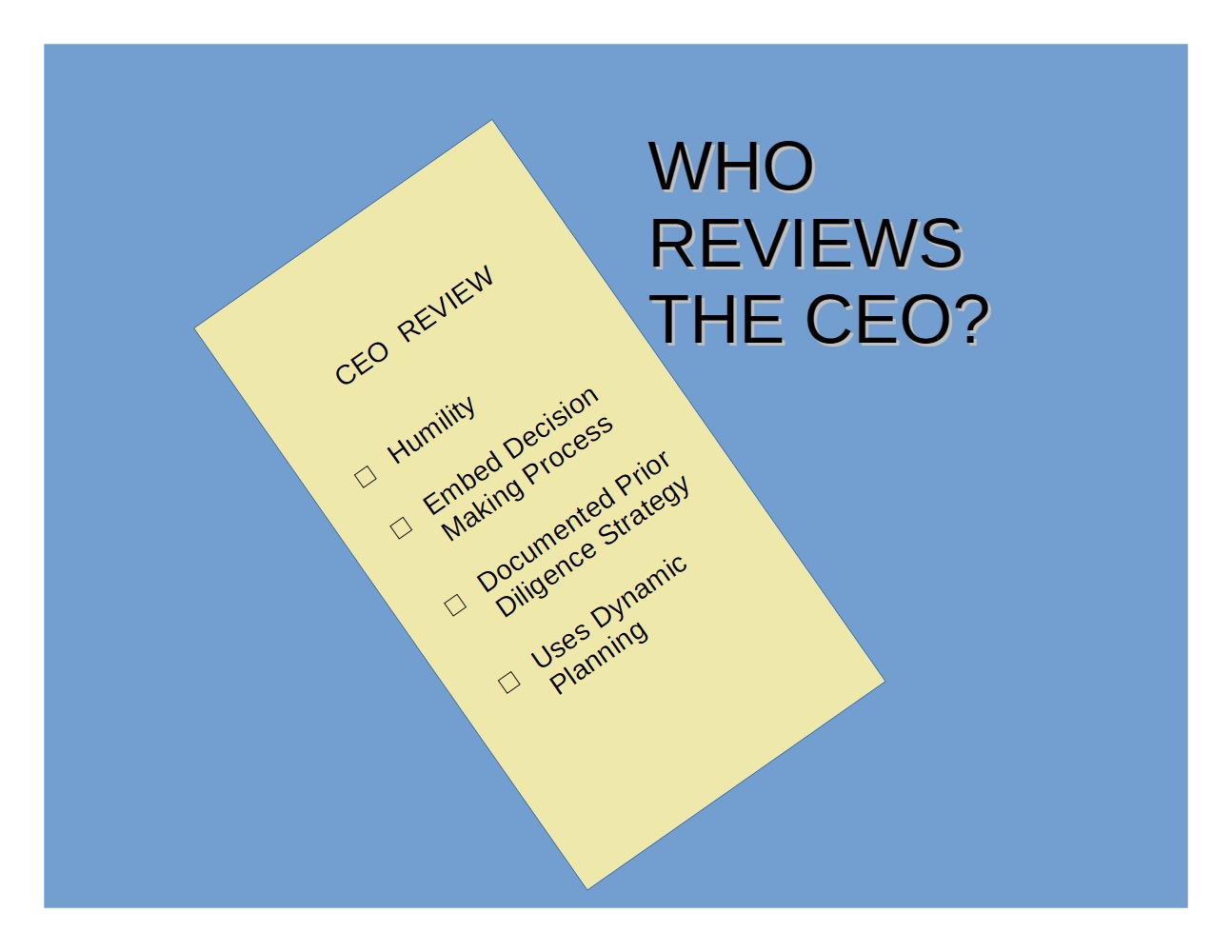
Most management experts recommend a review process for employees. This provides feedback in a constructive environment to clarify expectations, critique past performance, and make recommendations about future opportunities. It seems logical to ask: who reviews the chief executive officer of the typical middle-market or main street entity? Sadly, the answer usually is nobody.
The CEO is often the owner and manager of the business. For the review of the controlling person in the business, it is difficult to find objective reviewers among the other executive officers. Of course, if there were a board of advisors who were not subject to direct control of the CEO, the review might be possible. The same could be said for a corporate board of directors made up of individuals other than the corporation’s executives.
Often, the obstacle to a board review is the CEO’s own reluctance to be reviewed. The most important leadership trait of a CEO is humility. For that reason, CEOs with strong leadership capabilities should welcome a constructive review process.
I advocate for the separation of ownership and executive control for a variety of reasons. Where there is this separation, ownership should be represented on the board and participate in a review of CEO performance. I also advocate for the review of the performance of the CEO by independent board members. Boards of directors or advisors can provide reviews of CEO performance including clear expectations, critiques of past performance, and recommendations about future opportunities.
If no one reviews the CEO of your business, the owners can decide how governance should work, including who reviews the CEO, as part of the Owner Agreement Project at Business Transition Consulting (btcllc.net). Complete the contact form and arrange a free initial consultation.