Author: BcAdm

  • Accomplish Continuous Improvement of Performance

    Accomplish Continuous Improvement of Performance

    To ask that every performance be better than the last is to place tremendous pressure on the performer. The aspect of performance is at the heart of most endeavors. Intuitively, we know that performance is not a constant, but in a competitive situation, the goal is for it to improve over a set period of time. It is not enough to ask for consistent effort. When we watch athletic performers, we see that champions have more than just consistent effort; they improve through sound decisions about innovative techniques, effective training, better equipment, and better mental preparation.

    In business, performance is the execution of a plan, which is the narrative of the decisions of the business. The cycle is well known: set goals, describe action, set mileposts, take action, evaluate, and revise. Assuming the creation of a quality plan, the quality of performance will depend on the execution of the plan. But initial quality is not enough. Business competitiveness requires consistently high levels of performance with an overall improvement of performance over time. This means that taking action, no matter how excellent the plan or the one-time performance, is not enough. It is not enough to repeat a high-quality performance through consistent effort. To achieve a consistent improvement in performance, the decision-making process of the business documented by the revision of the plan, including the revision of the actions to implement the plan, must be continuous.

    If a business creates a plan that is excellent and implements the plan with flawless execution, but performance does not consistently improve, the business will fail in a competitive environment. The part of the planning process that creates success in a competitive environment and that causes performance to consistently improve, is evaluation and revision.

    How often do we see businesses taking months to create strategic planning, then finally implementing the plan, only to take months to evaluate and then revise the plan; in essence, taking the same time and resources required to create a new plan. No matter how good the plan, constantly recreating plans and implementing them will not accomplish consistently improving performance.

    Consistently improving performance is accomplished through constant evaluation and revision of planning coterminous with experience. Experience and evaluation cause revision, and the revision to the plan should be written. How can evaluation result in coterminous revision of the plan?

    The plan starts with the decisions of the policy-making group about strategy. The action plans are implemented by the executive officers. As the action plans are being executed, those charged with executing the action plans will change the plans to accomplish the task. The experience will be evaluated frequently by those from the policy-making group. At the highest level, the policy-making level where strategic planning is adopted, the planning does not have to be revised as much as at the operational level where action plans are being executed. It is at the operational level that the planning is frequently changed, but the changes are not documented. These informal changes are often what accomplishes the action plan, but frequently others in the business, especially those in the policy-making group, do not know about these changes. Frequently that is because those who change the plan are not sure they have the authority to change the plan but the changes are done to accomplish the task.

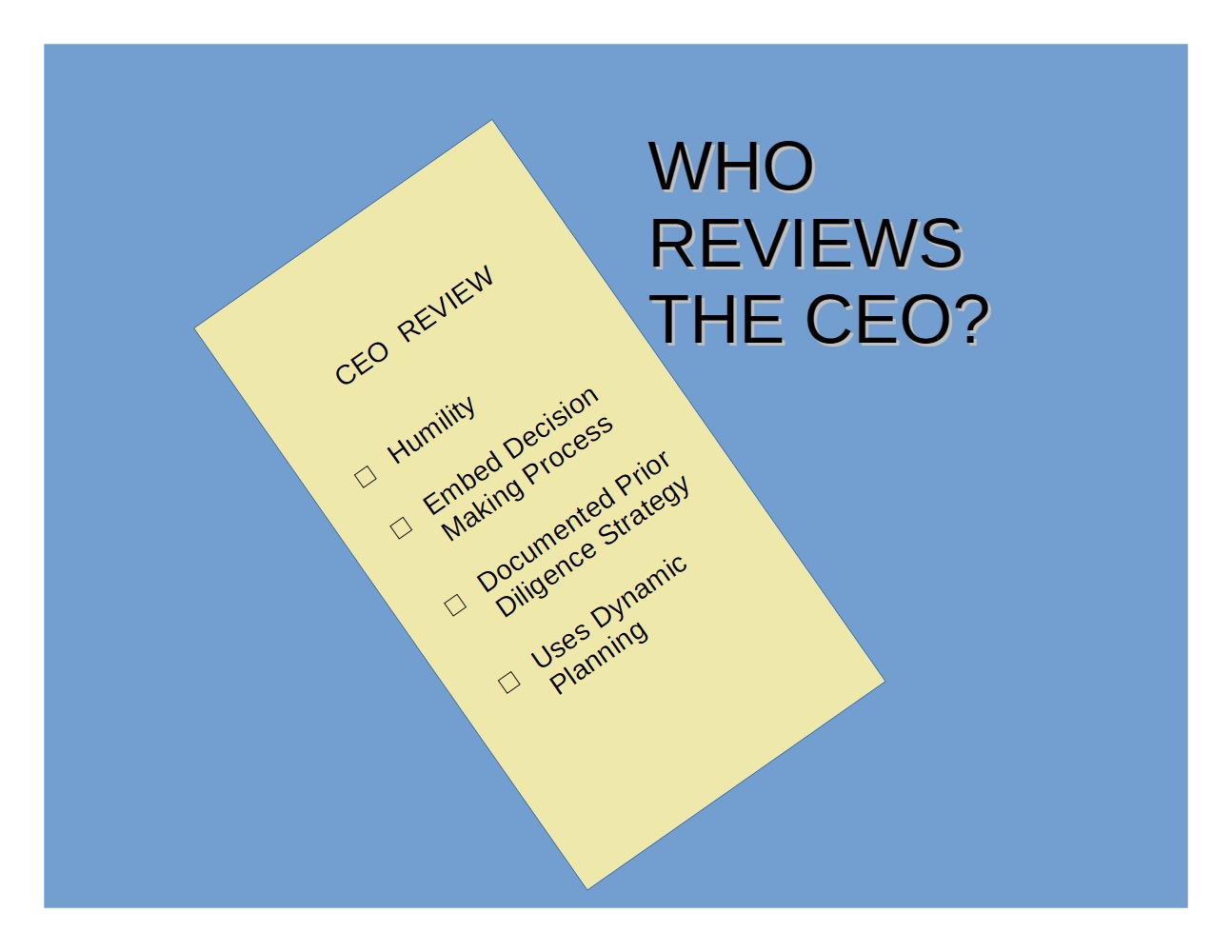
    If the members of the policy-making group do not know about changes to the action plan, their evaluation and further planning will be flawed. Those taking action should be able and required to amend the action plans. In this way, changes are communicated up and down the hierarchy of management. Moreover, changes are occurring with experience, and revisions to the plan are written contemporaneously with the decision to change at the operational level. Those charged with the execution of action should be empowered and required to change the action planning. When this is in place, the plan becomes dynamic – an effective form of communication within the business.

    Planning is the communication of the decision-making process of the business. The constant questioning of goals, selection of actions, identification of mileposts, and determining revisions should be a series of seamless, constant activity. It is this activity that will enable consistent improvement of performance over time. In business, we must do more than ask employees for increased effort to accomplish improvement of performance. We must establish a process to make good decisions that are documented in dynamic planning that is constantly evaluated and revised at all levels. That is the essence of championship business performance – continuous improvement in performance over time.

  • The Time Thief

    The Time Thief

    We have all been there. Rearranging the deck chairs on the Titanic. There was always an unspoken vision – never written but certainly desired. But things got in the way. The problem was that so many issues came up. There was never a quiet period when things could be thought out. There was never enough time to do it right. Then there was no time at all, and what we were doing was too little too late.

    How many business owners have you been aware of who have never derived full value out of their business? Some owners could not realize their business dreams because of a health issue or burning out. Some owners were forced out by other owners. Most owners fail to realize maximum value from their business simply because no one would buy their business for full value. These owners did not receive full or maximum value from their business because they did not plan, and then all of a sudden, what they were doing was too little too late.

    Having an owner agreement with buy-sell provisions protects the value of the interests of owners who cannot be involved in the full cycle of the business. Planning for the sale of a business for maximum value is the way to obtain maximum value for a business interest. But most businesses do not have written plans. Why? Business owners will tell you it is because they never had time to plan, but that is not the reason.

    You will not have time to plan if you continually do those tasks which are urgent but not important over those tasks that are important but not urgent. The business owner should prioritize time for creating a written strategy, implementing a plan from that strategy, and revising the plan as it is executed. Not doing that by prioritizing urgent but not important tasks that could be delegated is a form of procrastination – a fear of the difficult tasks involved in the important activity of planning. For a multiple-owner business, the values of the owners should be articulated one to the others and a strategy, like the Prior Diligence strategy, developed from those conversations. This is not easy, and it requires quality time for the owners to communicate. From this strategy, a plan of action through Dynamic Planning should be developed through group decision-making involving all elements of the business. This is also difficult, but it can be accomplished, and it becomes easier as a group decision-making policy becomes embedded in the business. Don’t let the time thief steal your chance to get full value from your business. Learn how at the Owning a Business substack (https://rickriebesell.substack.com/welcome).

  • Delegate – Unlock the Maximum Value of Your Business

    Delegate – Unlock the Maximum Value of Your Business

    Owners of small to medium sized businesses often find it hard to delegate management tasks. This is especially true of founders of the business.

    Here is a critical truth: to the extent you are engaged in management of the business, you are decreasing the value a buyer will pay for the business. A buyer wants a business that runs itself, not one that depends entirely on you and other owners. Full delegation of management responsibilities is not just a way to reduce your stress; it’s part of Prior Diligence, a strategic move to unlock the maximum value of your business through a successful sale.

    How can you implement delegation of management? It requires a structured, multi-step approach that shifts responsibilities from you, the owner, to your capable business team.

    The first step is to audit what management work is done by owners over a period – perhaps a week, or even for a month. Identify the tasks that are urgent but not important – repetitive, non-strategic tasks such as routine administrative work, scheduling, or data entry. Also identify the important but not urgent tasks – strategic planning, monitoring of operations, and leadership activities – which are ownership tasks.

    Review the personnel available for delegation in terms of willingness to accept additional work, current skills, and potential for growth.

    Initially delegate urgent but not important tasks to the right individuals to successfully accomplish the tasks. The delegation must be a clear communication of the task and the expectation of performance. If the task is not described clearly, the performance may not meet the expectation of the delegator. On the other hand, if the performance desired is not clearly defined, it will be difficult to recognize the success of the accomplished task. The description of the delegated task should include quality standards, non-negotiable details of desired procedure, the action that defines accomplishment, and the specific time for completion. To avoid micromanaging or hovering, set regular milestones with specific metric standards that will indicate progress and be instances of mutual communication to prevent misunderstandings or failure to complete the task on time.

    Ensure the person receiving the delegation communication has the necessary authority (access to systems, permission to spend up to a certain amount, and decision-making power) and resources (tools, budget, and training) to complete the task without needing to constantly revert to you. If the task is new to the person receiving the delegated task, provide coaching or written procedural instructions as to how to accomplish the task.

    Where there are problems, the communication protocol should require the delegated party to offer a proposed solution to the problem presented.

    The delegation process is not complete until the task is finished and reviewed. Once the task is finished, meet with the employee and provide feedback. Praise effort and recognize accomplishment. Provide constructive guidance on what could be done to improve performance and accomplishment in terms of the specific task delegated and the goals of the business plan. Ask for feedback from the party having accomplished the delegated task to help you improve your delegation process.

    Utilize the success of this task accomplishment to build confidence and trust for both the delegating party and the party accomplishing the delegated task. As the individual demonstrates competence, gradually increase the complexity and scope of the tasks you delegate to the employee, transitioning from delegating a single task that is urgent but not important to delegation of an important function (for example, from running one report to being responsible for the entire monthly reporting process).

    The steps to implementing effective delegation of management tasks from a business owner to an employee of the business are: audit the tasks completed by an owner in a period, identify the tasks into two categories – urgent but not important and important but not urgent, review the personnel to receive delegated tasks for skills to accomplish the task and willingness to accept the delegation, delegate an urgent but not important task with clear communication, establish milestones to measure progress and signify times for communication, recognize accomplishment of the task with feedback recognizing effort as well as accomplishment, and receive feedback on your delegation process.

    You can be the owner who successfully delegates managerial responsibility to employees and thereby increases the probability of utilizing the Prior Diligence strategy and Dynamic Planning to receive the maximum value from your business interest. Complete information on the Prior Diligence strategy and Dynamic Planning is available at the Owning a Business Substack (rickriebesell.substack.com).

  • The Risks of Not Implementing an Owner Agreement

    The Risks of Not Implementing an Owner Agreement

    Owners of small to medium sized businesses want to realize the maximum value for their business interests. There are many risks preventing realizing maximum value for a business interest – most can be avoided by the implementation of an owner agreement.

    Where an owner does not hold a controlling interest, there is the risk that the owner will not have control over the outcome of certain business transactions that may diminish or terminate the owner’s interest.

    There is an increased risk of misunderstandings and conflicts. Where there is no written owner agreement, there are no defined rules for how the business should be run, how decisions are made, how profits are distributed, or how disputes are resolved.

    The risk of failing to secure a loan or investment is increased. Banks and investors often want to see a comprehensive owner agreement.

    What happens if one owner wants to leave, retires, becomes disabled, or passes away? The termination of an owner’s interest can happen through involuntary circumstances, such as death or disability, or through voluntary withdrawal for personal, family, or other reasons. Without an owner agreement containing buy-sell provisions, the risk of the remaining owners being forced into business with an uninterested or inexperienced third party (such as a spouse or child) is increased. Also, the risk of the business being forced into a costly and time-consuming dissolution process is increased.

    Most businesses do not have an owner agreement among the owners because it is difficult to negotiate and implement an owner agreement among the owners of a closely-held business. Often the subject matter is difficult to discuss, and the pressures of operating an owner-managed business make it difficult to find the time needed to accomplish this task. The benefit of implementing an owner agreement for the owners of a small to medium-sized business is that for each owner the risk of not realizing the maximum value for the owner’s business interest is greatly reduced. This makes implementing an owner agreement worthwhile.

    As with most complex and difficult tasks, it is best to use a segmented approach and address the various issues one at a time.

    The issues that must be discussed and decided upon can be generally described. The business entity type of the business should be understood and described in terms of liability and tax consequences for each owner. The group of individuals or entities that own the business should be defined and appropriate restrictions should be put in place. The governance of the business, including who will make policy and who will be the chief executive, should be clearly specified. The events (triggers) that will cause one or more owners to transfer interests in the business should be defined. The procedure of the transaction occurring after each type of trigger, including funding and payment, should be provided for in detail. For each transaction, the determination process of the price of the transferred interest should be clear. If the business will act as a buyer in certain procedures, then the means of the business accumulating the funds for the transaction should be provided for in detail. A dispute resolution process should be described. The final task is the consolidation of the decisions into one coherent written document.

    There should be a meeting of the owners and appropriate stakeholders to discuss each one of these general issues. For each issue there should be a separate meeting. The meetings should be held at regular intervals. The decisions resulting from the meeting discussions must be documented in writing. Where issues are technical or outside resources would be helpful, they should be utilized. The documented decisions resulting from these discussions, consolidated into one coherent document, will constitute a succession plan for the business.

    The succession plan is the basis for the drafting of the owner agreement, a written document. Even though this is a written plan to which the owners have agreed, each owner must have separate counsel to review and advise each owner concerning the written owner agreement.

    With an owner agreement in place there will be an agreed-upon rulebook for operating the business. This will prevent disagreements and help keep focus on business success. Moreover, the business will be protected from unexpected events ensuing a smooth transition if an owner leaves the business.

    The owner agreement is a way to document the strategy of the owners to realize maximum value from their business interests. This is the Prior Diligence Strategy accomplished through Dynamic Planning. These concepts are explained in detail at the Owning a Business Substack at rickriebesell.substack.com.